

-
Capturing live events for Apple Immersive Video: Learnings from "Metallica"
Learn how to approach large-scale live events for Apple Immersive Video. This session covers the importance of access, mapping stage layouts, placing cameras effectively, and analyzing previous performances to anticipate the show. Using the Apple Immersive title "Metallica" as an example, you'll also see how pre-vis in Apple Vision Pro and stabilized capture systems help capture dynamic performances while maintaining comfort.
This session was originally presented as part of the Meet with Apple activity “Create immersive media experiences for visionOS - Day 2.” Watch the full video for more insights and related sessions.资源
相关视频
Meet with Apple
-
搜索此视频…
My name is Ivan Serrano. I'm the technical director for Apple's immersive media team. Today we're going to talk about all the lessons learned on capturing immersive live events for VOD or live to tape. Not to be confused with the live live, which I know everybody's excited about.
We all love going to live events. There's something exciting about being in the crowd, whether it's watching Steph Curry dropping threes from half court at the All Star game or LeBron James at 40 years old, throwing down monster dunks. These moments stay with us. They're not just entertainment. They're shared experiences.
Live sports are some of the most immersive experiences we share. The tension, the rhythm, the unpredictability. It's all unfolding in real time. And just as the playoffs are ramping up. We're so emotionally invested, whether we're in the stadium or watching from home. With VIP Yankees, we had a rare opportunity to shoot immersive by placing a camera inside the dugout not just to film the players, but to capture the pulse of the game from their perspective. Now, if sports gave us a taste of proximity, and what we're going to talk about today is Metallica, which handed us the full spectrum, proximity and immersion.
We weren't just close to the action, we were inside it. We had access to the tuning room, backstage pyro cues, crew comms, and even fan POVs. It wasn't just about getting great angles, it was about capturing the heartbeat of the show.
This project taught us how to film, not what just is happening, but what it feels like to be part of it. That's the essence of immersive capture. But what does success really mean in this format? Putting a camera closer than the front row. Being just in front of Lars and capturing presence and momentum.
Or James walking to the stage just feet from the fans. Capture from within the barricade, shoulder to shoulder with security.
Or on stage with Kirk jamming to Master of Puppets. You're not watching the band. You're with them. Every stomp, every solo. This is what it feels like to be on stage.
But it all wasn't perfect in the beginning.
This is where we started. I'm sure everybody knows what these are, and most have seen these types of cameras at every sporting event or concert. It's a long lens where you can be 100ft away and still get that nice close up. Sup. Using a 20 by or 100 by lens, or this one. Almost any time you walk into a theater, this is where they place you in the camera pit, out of the way again, hoping you have that super long lens. When we first started filming immersive events and after multiple shoots, most of the event management just simply put us next to those cameras. And of course, we learn that it just doesn't work.
But really, what are the most important things we learn to deliver? An incredible immersive experience is the access. And that's where the real challenge begins. Getting cameras as close to the action as physically possible. And regardless of its sports or concert, prime locations are tough to get. You're negotiating with broadcast crews, navigating through security zones, and working around legacy workflows like Metallica's.
So how do you break through it? And that's the groundwork.
And it started with Apple's creative team traveling to meet the band face to face, sharing demos, concepts and ideas for how they could deliver a whole new experience to their fans.
And after watching some of Apple's immersive videos, the immediately saw the potential this band has been innovating for decades. That shared drive to collapse the wall between artist and fan, becoming the foundation for this ambitious, immersive film.
Their access shaped how we designed coverage. Every camera placed within with intent, every angle mapped to their movement.
But before we talk camera placement, we had to discover the stage layout. This wasn't just a stage. It was a circular blueprint for immersion.
The snake pit at the center. Fans wrapped around the band. Energy moving in every direction as we scouted through their concert in Minnesota. Their team walked us through their entire stage design, provided us drawings of the stage, and even walked us through where they placed cameras for their 2D capture. We weren't just looking for good angles, we were learning the architecture of the experience. With that level of access, we could place cameras in zones that are usually off limits, but to make those placements count, we had to understand how the band moves. The team watched over 30 performances from the tour to map the band's movement show after show. They even gave us ISO feeds of cameras like the Spidercam to understand to best position our aerial camera. This increased our chances of knowing exactly where the magic would happen.
We then brought these models into Vision Pro, allowing us to preview every camera angle in immersive, where we could test everything from camera speed and positioning to feeling the physical effects of movement.
And here is the camera plot. This layout shows 14 cameras positioned around the stage. Each one was chosen for a reason. Proximity to key band members, fan energy zones, and movement paths.
We mapped the stage very strategically, anticipating solos, crowd surges, and moments of intimacy. Some cameras were fixed, one flying and others in remote dollies.
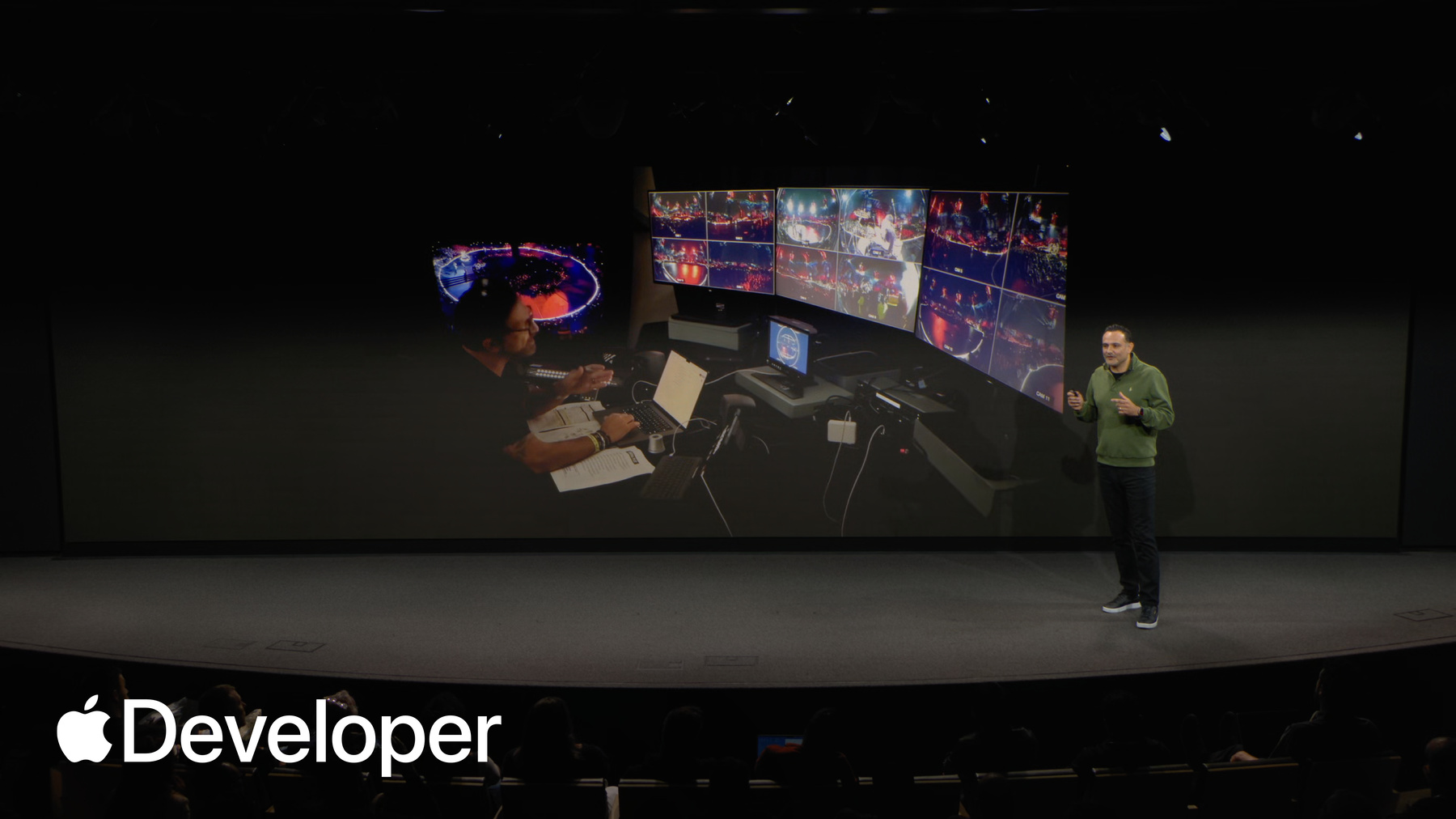
And with all the access and Intel we got from this band, this is what it looks like sitting next to the director, Mark Ritchie.
Even though the the 14 camera shoot was VOD, it was live directed in real time as the show unfolded. This was the largest multicam concert setup the team has ever done.
And to bring this experience to life. Not only did we need access, we needed the right equipment that could move with the moment.
Knowing the nature of rock and roll, all of our cameras were stabilized, including this new Steadicam by Tiffin using the volt three system.
This is also the camera that followed James as he entered the stage right through the heart of 60,000 fans in Mexico City, giving the viewers the feeling of walking with him.
And this rig right here that put us above and beyond the stage, the spidercam giving us unique perspectives like this.
Sweeping aerials, dynamic transitions and angles that traditional rigs simply can't reach. This wasn't just coverage, it was choreography between gear and performance. Every tool was chosen to match the energy of the environment and the emotion of the moment.
So to summarize, to deliver a truly immersive capture, it starts with access, because without it, you're just guessing. From there, map the stage, study the choreography, and if possible, build your previs in 3D to lock in your camera plan and finally match your gear to the environment. Because the right equipment lets you focus on the moment and not worry whether your footage will survive. Post.
As a result, immersive mediums don't just tell a story, they let you live it. And that's louder than words. And for those who haven't seen the film yet, here's a sneak peek.
Are you alive? Take my hand. Who walks in? Never, never land. Ha ha! Thank you everybody.
And now to speak about unscripted storytelling and less controlled environments and more unpredictable productions. It is my pleasure to introduce to our creative director, Franz.
-