

-
Discover how DREDGE was reimagined for Apple platforms | Black Salt Games
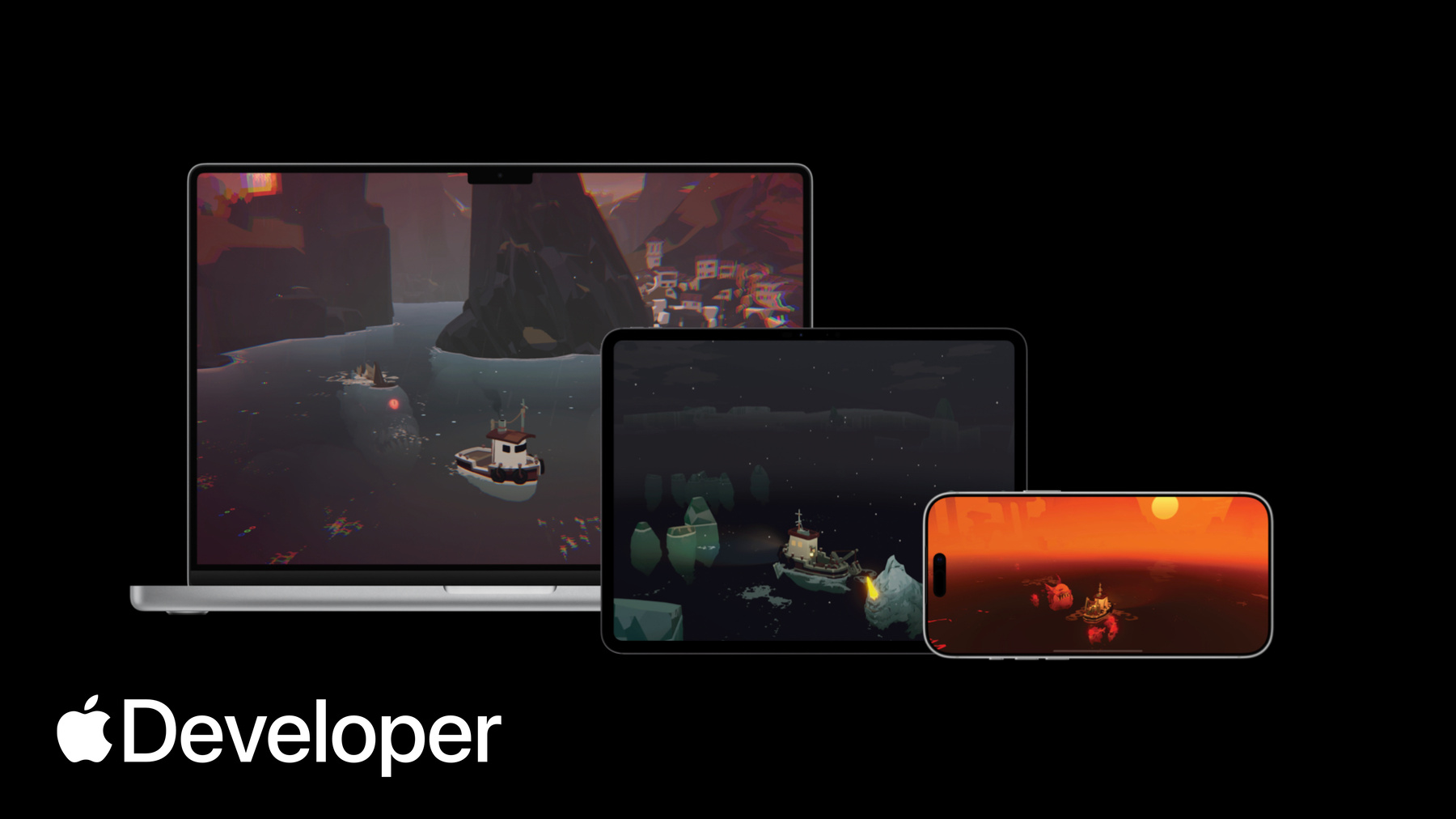
Find out firsthand how Black Salt Games rebuilt their indie hit DREDGE from the inside out, redesigning the game's UI, controls, and flow to make it feel truly native on iPhone, iPad, and Mac. Plus, learn how business strategies like Universal App support, long runway pre-orders, and “Try before you buy” powered the game's premium mobile launch.
This session was originally presented as part of the Meet with Apple activity “Press Start: Game development on Apple platforms.” Watch the full video for more insights and related sessions.Resources
Related Videos
Meet with Apple
-
Search this video…
I'm Nadia, CEO and producer at Black Salt Games. The team of four behind dredge, a fishing adventure where you play a boat that somehow became a global indie hit.
Today, I want to share how we took that success and found new depths on Apple's platforms. What we learned, what surprised us, and what it could mean for other premium Indies. Exploring the App Store as a platform for their games.
Before we focused on whether we could make dredge feel native, we had to ask ourselves whether we should.
And while we never expected our little cosmic horror fishing game to be a global hit, it was clear right from launch that players saw the possibility for the mobile version. It's a great game for travel and therefore mobile play. And except for a couple of technical challenges and design doozies. I'll get to those. So did we.
Once we had added and so much content to the game as we had wanted and frankly, could. By that point, we asked ourselves if we were up for tackling this next challenge to deliver the same dredge experience that carried in our players pockets. Give the players what they want. This philosophy guides how we craft our games. It's not about simply giving the players what they ask for. Obligatory. Henry Ford and his dubiously attributed horse quote. But it's also not about forcing your vision to fit their reality. You need to find a balance between the two where what you imagine and what they want to feel come together harmoniously.
We spent countless hours during the initial development of dredge watching players test our builds, making sure the controls were intuitive, that we were guiding players while still supporting the freedom of play, and that the game secrets were discoverable but remain genuinely surprising once they were found.
When we decided to bring dredge to the App Store, we knew we'd need to revisit many of those foundations from the beginning. Controls had to be redesigned to support touch screens, and the overall game flow would inevitably change because of it. Our players trust us to provide an experience of escape, not one of buggy frustration. So if we were going to release dredge on mobile devices, it had to feel every bit as good as it does on PC or console, not a runner up version.
We did have an ace up our sleeve that probably made an iOS conversion a lot less intimidating for us. We already were mobile developers. You can see it in how quickly we delivered dredge with such a tiny team, and how tightly optimized our assets are.
What, ten years in mobile game development taught us is discipline, working to minimum spec, and the constraints of making a performant and atmospheric open world game that runs well on mobile devices is a habit that stuck with us.
It means we still build our PC and console games with that same efficiency without ever compromising on quality.
And because of that approach, our games ran beautifully on Apple devices even from the beginning. And even though it's not a dedicated, dedicated gaming console, iPhones and iPads are more powerful than some of the consoles that we do have to build for.
There are still a few shader and battery life optimizations to sort out, but when it came to the nitty gritty of converting a mouse and keyboard or controller game into a touch game, our obstacles were mostly around the conversion of our gameplay and UI to support it. Three main ones really.
The first big job was the interface. Dredge's layout was designed for a nice wide 16 by nine display, and we made a conscious decision not to support anything squarer than 16 by ten. We couldn't accept that for our tablet users, though, we size the characters down slightly for some of the taller screen ratios. Redesigned the buttons so they felt tappable rather than just informative and adjusted how buttons responded. To touch on PC and console, you can hover over a button before you click it, and tooltips and prompts will appear to give the user more information. Hovering with your finger wasn't exactly viable, though. We spent a lot of time refining adjusting where elements were placed because of where thumbs naturally fall and how far they move. We ended up shifting parts of the UI, changing the sizes of buttons and making in-world UI prompts into Tappable buttons.
Touch controls sounds simple. In theory, you can just tap what you'd normally click or select with a controller, right? If only. But we knew right from the start that this would be one of the most critical things to get right.
One of our biggest concerns was visibility. Dredge is an open world game where the player is the boat, so being able to navigate the seas while still seeing the world around you is essential to the experience. We control that through two inputs movement and camera, which is easy enough with a controller or mouse and keyboard. But dual onscreen joysticks meant two thumbs, taking up a good chunk of the display. We worried it would pull players out of the experience, but we also didn't want to make our mobile version controller only. So once again, we prototyped.
To our surprise and relief, players found it completely natural, even immersive. That tactile sense of directly steering their boat without the usual layer of abstraction was actually preferred by some players over the desktop or TV experience.
From there, it was all refinement, supporting simultaneous inputs, adjusting thumb zones, accounting for tiny finger lifts, and tuning movement speed based on how much players pushed the joystick. A lot of planning and effort. Also, the players never have to think about it.
I always feel bad that our playtesters, while getting to see our games earlier than everyone else, also see and play the worst versions of them. The heroes we need but don't deserve.
Fishing is one of the core parts of Dredge's Loop. Go out. Catch fish. Come back. Sell. Upgrade. Repeat. Please do it hundreds, if not thousands of times in a normal playthrough, so it had to feel smooth and intuitive. But in dredge, we found the traditional flow resulted in too many misplaced items frustrating our players. So that had to change.
At first glance, it doesn't look like we changed much, but under the surface it was one of the biggest redesigns we did. We flipped some elements of the fishing UI and added a tap to bring up interaction for what was essentially our hover menu. That extra step might sound slower, but through testing we found it was actually smoother on touch, players were no longer picking up the wrong item and having to put it back down again.
Second, the fishing and inventory flow. Rotating fish is a really important part of our game. I promise it's a lot more fun than I'm making it sound, but it's not necessarily easy. If your finger happens to be bigger than the fish you're trying to spin.
Pricing is always the elephant in the room when you bring a premium indie game to mobile. There's this long standing idea that mobile games have to be cheaper, that players won't pay the same price they would on PC or console.
But we weren't bringing a discount version of dredge. This was the full experience, built and refined with the same care and scope as every other platform. So we decided early on to keep price parity with our other SKUs. Launching at US 24.99 for an average ten hour playthrough.
If we were going to take that untraditional route when most premium games are priced 30 to 50% lower on mobile, we needed to make sure players were getting real value for their purchase, that they felt confident in what they were buying. And for us as a business, it was important to have as much visibility on our launch as possible.
One of the biggest ways we added value was through Apple s Universal App system. It's one of only two true cross-platform versions of dredge one purchase that works across iPhone, iPad, and Mac and carries your saved data between them.
Technically, there are separate code bases. Our Mac build is based on the PC version and our mobile build on iOS. But for players, it just works. You can play a few minutes on the train, then pick up exactly where you left off at home. That kind of flexibility makes the premium price feel worthwhile, because you're not only getting what PC gamers get. You additionally get to play that game on your phone or tablet.
Try Before You Buy was suggested to us by Apple early in development to give players confidence in their purchase.
As PC and console developers, we're used to releasing demos, so it immediately made sense. It's a model that lets players check that dredge runs well on their device, and more importantly, that it's the kind of experience they're looking for before committing to purchase.
It's performed really well for us. The conversion rate from Try Before You Buy is around 30% higher than when that same paywall sits up front on the store page. It's simple and it builds trust. Players get to experience the game firsthand, and when they decide to buy, they're already confident and invested. Our trial allows players to explore the first of five biomes takes, on average, about two hours to complete, so accounts for about 20% of the overall experience.
Preorders were a big part of our launch strategy.
They're available for up to six months on the App Store, which gave us a long runway to build awareness before launch. Actually, Dredg launched with more preorders on the App Store than it had wishlists on steam, a dedicated gaming platform. So that speaks to the reach of App Store preorders, and those preorders mattered. Players who preordered on the App Store went on to purchase at around four times the rate we've seen on other storefronts, and in the first six months, those preorders accounted for roughly 4% of our mobile sales.
Since launch in February. This year, we've reached over 1.5 million players via the App Store. Many of them are in places where console gaming isn't the norm. India and parts of Southeast Asia. And that's been incredibly rewarding.
We talk a lot about accessibility in terms of mechanics, but for us this was accessibility and reach, bringing the experience to people who wanted to play dredge but simply couldn't play it before.
Critically, the reception has been fantastic. We've had strong player reviews, industry recognition and Dredge Mobile has also earned several awards, including New Zealand's second ever Apple Design Award for innovation. That one meant a lot because it validated the decisions that were hardest to make. The UI redesigns, the control reworks and of course, the endless testing.
Financially, it was a positive return within the first month of launch, even though it was our most expensive conversion, because we did take the time to make sure it was purpose built for these devices. And yes, even though our game is priced at $24.99 on the App Store.
Looking ahead, I think the opportunity for premium games on Apple platforms is only getting stronger. Discoverability is always a challenge. But the new Apple Games app is a great example of Apple responding to both developers and players feedback. Giving players a more focused space to find games they'll love, and amplifying the ProMotion of your most valuable acquisition channel. Word of mouth. For us, bringing Dredge to mobile was never about chasing another platform. It was about making the game accessible to more people without compromising what made it special, or lowering the quality and user experience standards that we hold our games that have our name on them, too.
Because if there's one thing this process has reinforced, it's that players everywhere respond to quality and care.
So to sum it up, Apple made it easy for us to add real value for our players. The universal app try before you buy preorders. Those are systems that make it simple for developers like us to give players more flexibility and confidence in what they're buying.
We want to dredge to feel great on these devices, not just run on them. And we did have to spend some time redesigning the UI and wrestling with controls, but a lot of that was our own decisions coming back to bite us. It was our first PC console title, and now we know how to make more platform agnostic decisions from the start of development. But all of it was worth it. Dredge looks beautiful on Apple devices and plays seamlessly across them, and it feels right at home on Apple's platforms. For us, this was never about just adding another SKU. It was about doing it properly, adding value for our players without compromise. And we learned how to make our games more adaptable in the process. Now back to Cupertino.
-